February 8, 2012

Rythmik T20 baffles

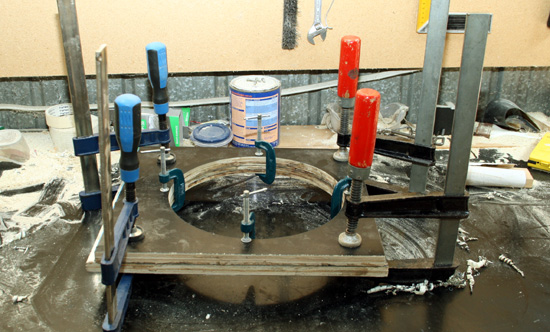
Double layer baffle (2 x 17mm formply). Holes cut with a router jig, then sanded rough and glued together with construction adhesive.


After removing the "ooze." 


February 7, 2012

TD18 bass bins

Grooves over butt joins to be filled:


Polyurethane glue was  used to add the baffle as it expands to fill voids. 


Sanding in progress:


F20 build pics

F20 assembled:


February 4, 2012

More progress - AE TD18 bass bins and F20 bass horn

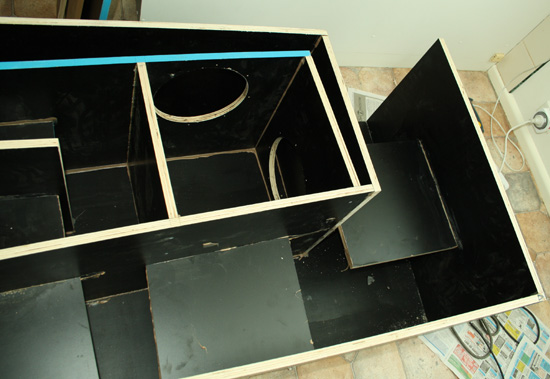
Two bass bins now assembled sans outer baffle. 


Internal bracing:


I wasn't quite careful enough drilling into the ply, so it split apart. I used polyurethane glue to repair it. In the past I've used PVA but it's difficult to get the glue in. With PU glue it expands to fill the void, so that it pushes the glue both into the void and out. The glue seen on the outside is there only due to the expansion. This glue is four times stronger than PVA.


F20 part-assembled:


Driver cut-outs were done with a router jig:


Bass horns in progress

All sheets now cut for two bass horns - F20 (lilmike's design on AVS) and T20 (dual Rythmik tapped horn). 

T20:


F20:


What you see is low cost Chinese form ply purchased for the same price as MDF. Not recommended as a rule but my T20 will be installed out of sight - it simply needs to be light and strong. It is quite a bit lighter than MDF and needs less bracing. 

Acoustic Elegance TD18H active woofers

100L sealed boxes in progress for Acoustic Elegance TD18H active woofers. Built with 18mm marine ply. Being low cost imported ply there are obvious shortcomings - voids can be seen in the cuts, but at around $80/sheet there isn't much to complain about.


The bracing is very simple. Just one horizontal and vertical matrix brace with a driver cut out. It isn't necessary to cut lots of holes in the braces, the volume gained is minimal, the braces are weakened and more effort is required.

Cutting braces:


Clamping and gluing bracing together:


Cutting driver holes:


If one cares about the appearance of the cut out that will not be seen, a router can be used to cut the full depth. However, these days I prefer to do things quicker so I start with the router, but don't go full depth. I then cut with the jigsaw. (That isn't me above, as always I'm the one taking the photos.)


Progress so far:


This box is very simple. The outer baffle needs to be added, then the other fives sides and the box is assembled.


February 1, 2012

Two 20 Hz bass horns


1. Lilmike's F20 modified to suit dual AE 10" drivers (PB10) - a front loaded 20 Hz bass horn
2. Rythmik T20 - a dual opposed tapped horn with dual 12" drivers


Black: T20 (Rythmik) 2 x 12"
Grey: F20 (AE) 2 x 10"


Black: T20 (Rythmik) 2 x 12"
Grey: F20 (AE) 2 x 10"

T20 has more output but it is due to greater cone area and excursion. F20 needs 80w in total and a high pass at 25 Hz for max SPL. T20 can use all of the power in the plate amps (2 x 370w) and needs a high pass at 20 Hz. 

Both of these will be constructed from formply at the same time, measured and compared.